Resource
Language
Smart Reading Glasses are moving from novelty products toward practical vision and information tools. They can enlarge text, adjust focus, display prompts, and support hands-free reading. The need is substantial. The World Health Organization’s World Report on Vision states that at least 2.2 billion people have near or distance vision impairment globally. At least 1 billion cases could have been prevented or remain unaddressed.
Market data requires careful interpretation. IDC’s Worldwide AR/VR Headset Tracker covers broader immersive hardware, not reading glasses alone. Grand View Research also separates smart glasses from conventional prescription eyewear. These differences make supplier comparisons less straightforward. A reported market figure may include industrial devices, entertainment products, or camera-enabled frames. Buyers should ask what each number actually measures.
This guide examines leading Smart Reading Glasses suppliers for international purchasing teams. It considers optical performance, display clarity, battery endurance, lens customization, software compatibility, and production capacity. It also reviews factory experience, quality documentation, sample consistency, and after-sales support. A useful test is simple: place the glasses over small print, walk through a bright warehouse, and check whether text remains stable. Privacy deserves equal attention. Suppliers should explain data storage, microphone controls, firmware updates, and user consent practices. Certifications matter, but certificates alone do not prove daily comfort or dependable reading performance. That is where many comparisons become too optimistic. Real samples, transparent specifications, and verified customer feedback remain essential before placing a large order.
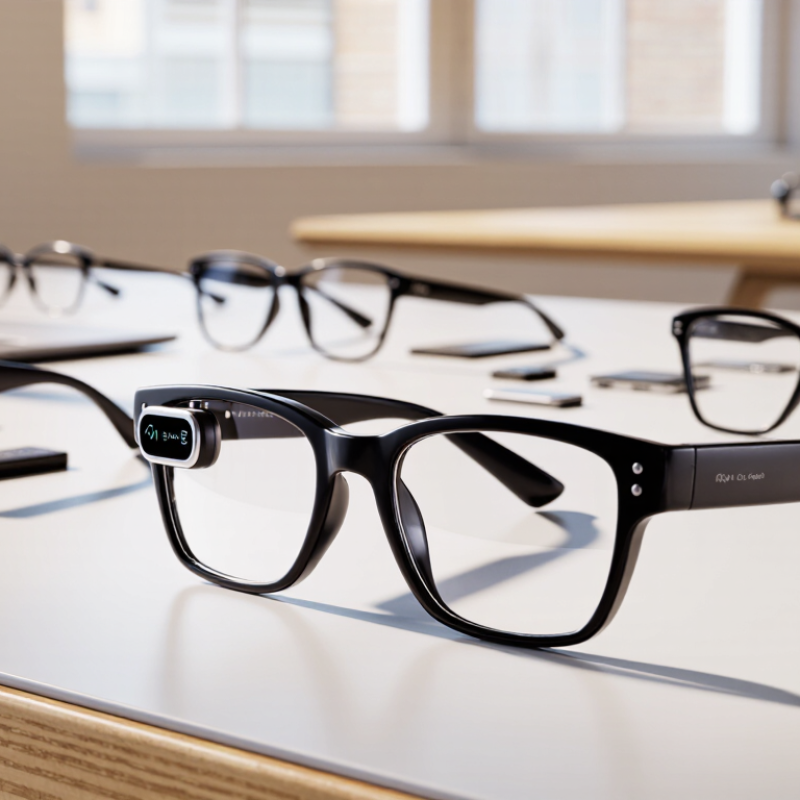
Smart reading glasses combine optical assistance with small electronic systems. Unlike ordinary reading glasses, they may adjust lens power, enlarge nearby text, or display digital information. Some models use electronic lenses, while others rely on cameras, sensors, and a connected mobile device.
The working process is fairly precise. A distance sensor estimates how far the wearer is from a book, label, or screen. A processor then changes the lens setting or activates magnification. In display-based designs, a tiny projector places text within the user’s field of view. Batteries power these functions, so weight, charging time, and heat deserve careful testing. Small details matter.
Product evaluations should include clear print, dim rooms, moving text, and several face shapes. Reading comfort can change after twenty minutes. Suppliers should provide optical specifications, battery data, user instructions, and documented quality checks. Buyers also need to verify prescription compatibility and data-handling practices before placing large orders. No design is perfect. Electronic adjustment may feel slow, and magnified images can appear unnatural at first. A reliable supplier should acknowledge these limits instead of promising effortless vision. Testing samples with real users often reveals problems that laboratory demonstrations miss.
Global buyers comparing smart reading glasses should start with optical performance, not novelty. Grand View Research estimates the smart glasses market could grow at a 27.5% CAGR from 2024 to 2030. That expansion makes specification discipline essential. Check lens power ranges, adjustable focus, anti-glare treatment, and measured optical distortion. Ask for test reports, not attractive product images. Text should remain sharp at a comfortable reading distance, even under warm office lighting.
Battery behavior also deserves close inspection. Counterpoint Research’s 2024 Global Smart Glasses Shipment Tracker reported strong year-on-year category growth, but usage time still varies widely. Compare continuous reading time, standby duration, charging cycles, and replacement battery options. A lightweight frame is useful, yet poor balance becomes uncomfortable after thirty minutes. Measure total weight and pressure around the nose. Small hinges can fail early. Request hinge-cycle testing and spare-part policies.
Connectivity and privacy features separate dependable suppliers from uncertain ones. Compare Bluetooth versions, phone compatibility, offline functions, microphone controls, and software update periods. The International Data Corporation emphasizes interoperability and user experience as important factors in wearable adoption. Buyers should also verify regional charging standards and after-sales response times. No scorecard is perfect. I would include a trial period, because written specifications rarely reveal heat, glare, or reading fatigue. Real hands test better than spreadsheets.
| Comparison Dimension | Display-Based Reading Glasses | Camera-Assisted Reading Glasses | Audio-Assisted Reading Glasses | Custom OEM/ODM Supplier |
|---|---|---|---|---|
| Primary reading function | Magnified or projected text through an optical display | Text capture, recognition and digital enlargement | Spoken text, voice commands and reading assistance | Function set selected according to buyer specification |
| Typical optical configuration | Waveguide, microdisplay or near-eye optical module | RGB camera with image-processing software | Clear prescription or plano lenses with open-ear speakers | Single-vision, progressive, plano or customized lens platform |
| Lens options to compare | Plano, reading add power, blue-light filter and prescription-ready options | Plano or prescription-compatible lenses; verify camera alignment | Plano and prescription lenses; confirm frame compatibility | Buyer-defined lens material, coating, power range and fitting data |
| Magnification or zoom | Optical or electronic magnification; commonly evaluated from approximately 1.5× to 4× | Digital zoom depends on camera resolution, software and lighting | Usually provided through spoken descriptions rather than visual zoom | Defined by the selected optical and software architecture |
| Text recognition | Not necessarily included; depends on connected software | OCR capability should be verified for supported languages and fonts | OCR-to-speech may be available through a mobile application or cloud service | Language pack, OCR engine and cloud architecture can be specified |
| Connectivity | Bluetooth is common; Wi-Fi may be included in advanced models | Bluetooth and smartphone connectivity; Wi-Fi depends on product design | Bluetooth, commonly using Bluetooth Low Energy for control functions | Wireless protocol, app platform and regional frequency requirements are configurable |
| Battery and charging | Rechargeable lithium battery; runtime varies with display brightness and use | Runtime is strongly affected by camera, processor and wireless usage | Rechargeable battery; compare playback time, standby time and charging method | Battery capacity, charging connector and protection circuit should be documented |
| Target frame weight | Often higher than conventional reading glasses because of display hardware | Typically higher because of camera, processor and battery components | Commonly designed within approximately 30–50 g, depending on components | Weight target should be agreed during industrial design and engineering validation |
| Audio hardware | Optional; may use open-ear speakers or bone-conduction transducers | Optional speaker and microphone system | Open-ear speaker, microphone and echo/noise management are key evaluation points | Speaker type, acoustic output, microphone count and tuning can be customized |
| Mobile operating system support | Confirm compatibility with current Android and iOS versions | Verify camera, OCR and application support on Android and iOS | Confirm Bluetooth profiles and application support on Android and iOS | Software development kit, application ownership and update policy should be defined |
| International compliance checkpoints | CE, FCC, RoHS, REACH and battery transport documentation where applicable | CE, FCC, RoHS, REACH, battery safety and radio testing where applicable | CE, FCC, RoHS, REACH, Bluetooth qualification and battery documentation | Required certifications depend on destination market, radio functions and product claims |
| Privacy and data protection | Lower data risk when processing is performed locally | Camera images and recognized text require clear consent and retention controls | Voice recordings and cloud speech processing require privacy disclosures | Data hosting, encryption, deletion policy and regional privacy compliance should be contractually defined |
| Customization level | Frame color, lens type, packaging and firmware options | Frame, camera position, application interface and recognition languages | Frame design, acoustic tuning, voice prompts and application branding | Full product, software, packaging and user-experience customization |
| Quality documents to request | Optical test report, battery report, EMC test report and user manual | OCR performance data, camera specification, EMC report and privacy documentation | Audio test data, microphone performance, battery report and wireless test records | Bill of materials, inspection plan, reliability data, certification files and change-control procedure |
| Best suited for | Users who need visual assistance while keeping their hands free | Users requiring text capture, translation or scene-reading functions | Users who prefer spoken guidance or have limited visual access | Distributors seeking a differentiated product with controlled specifications |
Buyer note: Actual performance, certification scope, minimum order quantity, warranty terms and software availability should be confirmed through current supplier documentation and production samples.
Smart reading glasses suppliers serve different roles in the global supply chain. OEM and ODM manufacturers usually support large buyers with frame design, lens customization, firmware integration, and packaging. Their strength is production scale. Buyers should inspect optical samples, battery performance, charging stability, and voice-control accuracy before placing a large order.
Specialized component suppliers serve another important role. They provide lightweight batteries, micro-displays, Bluetooth modules, sensors, and prescription-compatible lens options. These partners influence comfort and reliability more than many buyers expect. A frame may look refined, yet feel heavy after thirty minutes of reading. Small details matter.
Regional distributors and optical retailers help convert technology into practical customer support. They understand local reading habits, fitting preferences, warranty expectations, and professional service requirements. For global buyers, this role can reduce communication delays and improve returns management. However, distributor claims still need verification through test reports and sample orders.
No supplier is perfect. A factory may offer excellent pricing but weak after-sales support. An optical partner may provide strong fitting advice but limited software resources. I would compare at least three suppliers using the same checklist: lens clarity, adjustment range, battery duration, data protection, repair process, and delivery consistency. Standards and documentation should be reviewed by qualified professionals in each target market. Cheap samples can mislead. Repeated testing is less exciting, but far more dependable.
Global buyers should evaluate smart reading glasses suppliers beyond catalog photos and low unit prices. Grand View Research estimated the smart glasses market at about USD 1.93 billion in 2023, with strong growth expected through 2030. That expansion attracts capable manufacturers, but also inconsistent quality. Request production samples, inspection records, optical test results, and a recent corrective-action report. Check lens clarity under office lighting, reading distance, frame pressure, charging stability, and battery performance after repeated use.
Compliance needs documented evidence, not reassuring emails. For connected eyewear, ask for applicable CE, FCC, RoHS, REACH, and IEC 62368-1 records, depending on the destination market. Battery-powered models should include UN 38.3 transport testing and clear safety instructions. TÜV Rheinland’s compliance guidance stresses traceable technical documentation and risk assessment for electronic products. Privacy controls also matter when glasses use microphones, cameras, or cloud services. Suppliers should explain data storage, deletion requests, firmware updates, and access permissions in plain language. A certificate without product-model matching is a warning sign.
Support quality becomes visible after the purchase. Require response-time targets, spare-part availability, firmware change logs, and a defined warranty process. IDC reported that extended reality device shipments declined in 2023, showing that demand forecasts can be unstable. Buyers should therefore avoid large commitments based only on optimistic projections. Ask for pilot orders and independent pre-shipment inspections. My own evaluation would still leave room for doubt: sample quality can exceed mass-production quality, and promised support may weaken after payment. Test the supplier twice. Once before ordering, and again before scaling.
Top Smart Reading Glasses Suppliers for Global Buyers
International Purchasing, Pricing, and Delivery Considerations
Global demand for smart reading glasses is expanding beyond novelty purchases. Grand View Research estimates the smart glasses market could grow at a 27.1% compound annual rate from 2024 to 2030. Buyers should compare optical clarity, battery runtime, microphone quality, and prescription compatibility. A low catalog price may conceal weak after-sales support.
Request landed-cost quotations rather than factory-only prices. Include tooling, packaging, spare parts, software access, warranty handling, duties, and freight. Incoterms 2020 defines responsibility for transport, insurance, and customs clearance. Small orders often look attractive. Per-unit freight can change that quickly. Build three scenarios: trial quantity, regular volume, and seasonal demand.
Delivery reliability deserves equal attention. The World Bank’s 2023 Logistics Performance Index assessed 139 economies across customs, infrastructure, logistics competence, tracking, and timeliness. Ask suppliers for production lead times, shipment records, inspection procedures, and contingency plans. Before payment, test samples under real reading conditions, including indoor glare and evening use. Check charging cycles and lens measurements. Some supplier pages remain vague. That is a warning, not a minor inconvenience. Forecasts can also be wrong, so a controlled pilot order protects cash flow and exposes defects early.
Indicative B2B purchasing benchmarks by product category, including typical wholesale pricing and production lead time.
Display-enabled reading glasses generally require higher wholesale budgets and longer production cycles than audio-only models. International buyers should confirm minimum order quantities, certification requirements, customization costs, shipping terms, and final delivery schedules before placing an order.
Compare lens power ranges, adjustable focus, anti-glare treatment, and measured optical distortion. Text should stay sharp at a comfortable reading distance. Test under warm office lighting. Product photos prove very little.
Ask for continuous reading time, standby duration, charging cycles, and battery replacement options. Check charging stability after repeated use. Small differences matter.
Yes. Measure total weight and pressure around the nose. Wear the glasses for thirty minutes during testing. Poor balance may cause reading fatigue. Hinges also deserve attention. Request hinge-cycle testing and spare-part details.
Compare wireless compatibility, phone support, offline functions, microphone controls, and update periods. Ask how data is stored and deleted. Check access permissions. Plain explanations are better. Privacy details can remain incomplete.
Request production samples, inspection records, optical test results, and recent corrective-action reports. Safety documentation should match the exact product model. A certificate without model matching is a warning sign.
Require response-time targets, spare-part availability, firmware change logs, and a clear warranty process. Ask what happens after payment. Support often looks strongest before an order. Test it twice.
Request a landed-cost quotation, not only a factory price. Include packaging, tooling, spare parts, software access, freight, duties, and warranty handling. Small orders may carry surprisingly high shipping costs.
A controlled pilot limits cash exposure and reveals defects early. Test samples during daytime, evening use, indoor glare, and normal reading. Compare sample quality with mass production. They may differ. Forecasts can be wrong.
Smart Reading Glasses combine vision assistance with connected functions such as adjustable focus, magnification, voice control, visual prompts, and wireless communication. This article explains how these devices work and highlights the key features global buyers should compare, including optical clarity, display performance, battery life, comfort, durability, software compatibility, customization options, and after-sales service. Understanding these factors helps buyers match product capabilities with the needs of different users and markets.
It also reviews supplier roles, from manufacturers and technology developers to OEM/ODM partners and specialized distributors, without focusing on specific brands. Buyers should evaluate production consistency, quality-control systems, product testing, certifications, data protection, technical support, and warranty policies. International purchasing decisions should further consider order quantities, pricing structures, sampling, customization fees, shipping methods, import requirements, payment terms, lead times, and delivery reliability. A careful comparison of these areas can reduce purchasing risks and support long-term cooperation.