Resource
Language
Electronic Progressive Spectacles are reshaping how vision correction meets wearable technology. These products combine progressive optical zones with electronic adjustment, sensors, batteries, and digital controls. They may help users shift between reading, driving, and screen viewing without changing glasses.
Steve Mann, a recognized wearable-computing pioneer, once wrote, “Wearable computing is about putting the computer on the person.” His observation remains relevant. Electronic Progressive Spectacles place adaptive vision technology directly in daily routines. Yet the category is still developing. Not every supplier offers the same optical accuracy, comfort, or clinical support.
This guide examines leading Electronic Progressive Spectacles suppliers through practical and technical criteria. We consider lens customization, adjustment speed, battery endurance, frame weight, user protection, and after-sales service. Certification and testing records also matter. A polished product page proves little.
Look closely.
Reliable suppliers should explain how their lenses respond to changing visual distances. They should identify manufacturing locations, testing procedures, warranty terms, and professional fitting services. Clear documentation builds trust. Independent reviews and optician feedback add valuable evidence.
The market has weaknesses. Some suppliers describe electronic eyewear broadly, even when their products only provide basic display functions. Others highlight prototypes without confirming large-scale production. Buyers should question these gaps.
Our comparison focuses on suppliers with verifiable capabilities, consistent product information, and realistic performance claims. It does not assume that the most advanced design is always the best choice. A heavier frame may offer more functions, but it can become uncomfortable by late afternoon. Careful evaluation remains essential for consumers, distributors, and optical professionals.
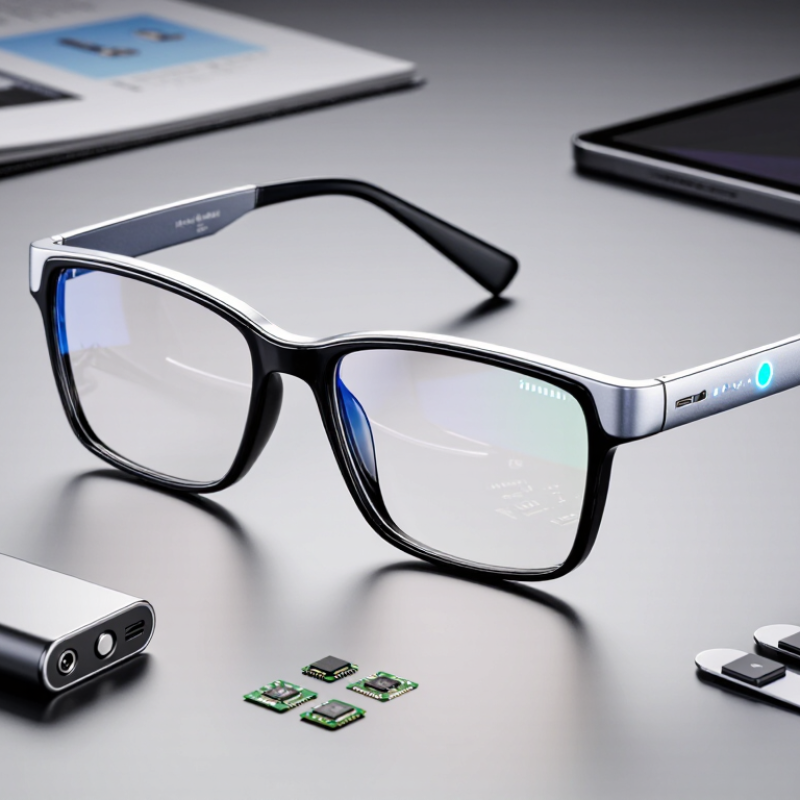
Electronic progressive spectacles are eyewear with electronically controlled lenses. Unlike fixed progressive lenses, they can alter optical power for different viewing distances. A sensor may detect viewing distance, while a controller adjusts liquid-crystal or electro-active lens elements. They are not automatically augmented-reality displays. Their main purpose is vision correction. The World Health Organization reported that at least 2.2 billion people had vision impairment in 2019, with aging-related conditions contributing significantly.
Core features include adaptive focusing, user-selected modes, prescription customization, and a compact power system. Some designs use gaze direction, head position, or manual buttons to select near, intermediate, and distance focus. Response time matters. A noticeable delay can disturb reading, walking, or stair use. Comfort also depends on frame weight, lens clarity, battery duration, and fitting accuracy. These details often seem less exciting than the electronics, yet they shape daily trust.
The broader smart-glasses market provides useful context. MarketsandMarkets projected growth from USD 1.3 billion in 2022 to USD 5.0 billion by 2027, or 30.2% annually. This figure includes more than electronically progressive spectacles, so it should not be treated as a direct category forecast. The market definition remains somewhat fuzzy. For supplier evaluation, documented optical testing and transparent battery data matter more than futuristic claims. Real-world trials should test glare, charging habits, prescription stability, and manual control. Marketing promises can run ahead of evidence.
This definition-based chart identifies whether a characteristic is essential to the concept of electronic progressive spectacles. A value of 1 means the characteristic is fundamental to the definition, while 0 means it is an optional feature rather than a defining requirement. Electronic progressive spectacles combine electronically adjustable optical power with progressive support for far, intermediate, and near vision.
Electronic progressive spectacles use adjustable optical elements instead of fixed lens zones. Tiny sensors may detect head position, viewing distance, or eye movement. A small processor then changes the lens power for near, intermediate, or distant vision. The adjustment can feel subtle. Sometimes, it is not instant enough.
During fitting, an optician measures your prescription, pupil distance, frame position, and usual reading range. These details help the spectacles select a suitable correction. Some designs use buttons, touch controls, or mobile settings. Others respond automatically. Lighting, posture, and battery level may affect performance. A careful fitting remains essential, even with advanced electronics.
Electronic progressive spectacles combine adaptive optics, sensors, and compact control electronics. Their lenses may use liquid-crystal or electro-active elements to change optical power. A small processor interprets viewing distance, head movement, and user settings. That response can shift focus when the wearer looks from a phone to a distant sign.
Sensors are central to this process. Inertial sensors detect head position, while ambient-light sensors adjust display brightness and contrast. Some designs use eye-gaze tracking, but accuracy depends on calibration, eyelid movement, and frame stability. A rechargeable battery powers the system through thin wiring and miniature power-management circuits. Heat control matters too. No wearer wants warm temples.
Practical testing separates capable suppliers from promising prototypes. Engineers should measure switching speed, optical clarity, battery endurance, and performance across different temperatures. Qualified optical professionals can also verify prescription accuracy and fitting comfort. Suppliers should provide calibration procedures, protection ratings, software support, and transparent test data. Bluetooth connectivity may improve updates, yet it can add power demands and privacy concerns. The technology is impressive, but not flawless. Calibration may drift. Motion can confuse sensors. Better designs should allow manual adjustment when automation fails. That small feature can protect confidence during daily use.
Top Electronic Progressive Spectacles Suppliers
Evaluating electronic spectacles suppliers requires more than comparing display resolution and price. Product comfort matters during ordinary work, not only during showroom demonstrations. Check frame weight, nose-pad pressure, hinge strength, and prescription-lens compatibility. A useful trial should include reading, walking, outdoor glare, and several hours of continuous wear. Small discomfort becomes obvious later.
Technical reliability deserves careful testing. Ask suppliers for battery performance under realistic brightness and connectivity settings. Examine charging cycles, heat control, microphone clarity, and response speed. Optical measurements should be documented, including field of view, image stability, and distortion near the edges. Request independent test records where possible. Polished demonstrations can mislead.
Supplier quality also depends on traceability and after-sales support. Review manufacturing controls, component sourcing, software update procedures, warranty terms, and repair timelines. Strong suppliers explain how user data is protected and how access permissions are managed. Speak with existing commercial users, not only sales representatives. Their feedback may reveal pairing failures, fragile parts, or slow service. No evaluation is perfect. A limited pilot with ten varied users can expose weaknesses before a large purchase. Suppliers that welcome negative findings often appear more dependable than those offering only impressive specifications.
| Evaluation Factor | Suggested Weight | Evidence to Request from the Supplier | Objective Data Point or Applicable Requirement | Scoring Guidance |
|---|---|---|---|---|
| Optical Performance | 18% | Optical test reports, prescription range, lens material specification, progressive corridor design, and sample inspection results. | Verify sphere, cylinder, addition power, prism tolerance, optical center accuracy, and consistency between production samples and approved samples. | 5 = complete test data and consistent samples; 1 = unsupported optical claims. |
| Electronic Adjustment Capability | 15% | Technical datasheet covering adjustment method, switching mechanism, response time, control interface, and operating conditions. | Confirm the measurable adjustment range, repeatability, transition time, operating temperature, and failure behavior when power is unavailable. | 5 = independently measured specifications; 1 = qualitative claims only. |
| Electrical and Product Safety | 12% | Applicable laboratory reports, electrical schematics, risk assessment, protective circuit details, and product safety test records. | For applicable products, evaluate alignment with IEC 62368-1 principles for audio/video and information technology equipment, including protection against electrical and energy hazards. | 5 = current third-party reports for the exact product; 1 = no traceable evidence. |
| Battery and Charging System | 10% | Battery chemistry, nominal voltage, capacity, cycle-life test method, charging time, protection circuitry, and transport documentation. | For lithium batteries, request evidence of applicable UN 38.3 transport testing. Confirm overcharge, over-discharge, short-circuit, and thermal protection. | 5 = complete safety and lifecycle documentation; 1 = unspecified battery source or protection. |
| Ingress and Environmental Resistance | 8% | Environmental test reports, enclosure design details, sealing method, and cleaning or maintenance instructions. | Where an IP rating is claimed, verify testing under IEC 60529 and ensure the rating applies to the finished spectacles rather than an individual component. | 5 = rating supported by a product-specific report; 1 = marketing claim only. |
| Quality Management System | 10% | Quality certificate, audit history, incoming inspection plan, process-control plan, nonconformity procedure, and traceability records. | ISO 9001 certification is relevant for general quality management. ISO 13485 is relevant when the product is developed or supplied as a medical device in the applicable market. | 5 = valid certificate covering the manufacturing site; 1 = informal quality controls only. |
| Regulatory and Market Documentation | 10% | Declaration of conformity where applicable, technical file index, labeling samples, user instructions, applicable test reports, and market-specific registration information. | Documentation must match the exact model, electrical configuration, lens configuration, and intended use. Regulatory requirements differ by destination market and product classification. | 5 = complete, model-specific documentation; 1 = generic or mismatched documents. |
| Manufacturing Capacity and Lead Time | 7% | Monthly capacity statement, production workflow, component availability, sample lead time, mass-production lead time, and contingency plan. | Compare quoted lead times with confirmed production capacity, component supply visibility, inspection capacity, and historical on-time delivery records. | 5 = capacity supported by records and realistic scheduling; 1 = unverified promises. |
| Customization and Engineering Support | 5% | Available frame geometries, lens configurations, firmware options, packaging choices, engineering change process, and prototype support. | Evaluate whether changes can be controlled through drawings, revision numbers, approval samples, firmware versions, and documented engineering-change notices. | 5 = controlled customization with engineering ownership; 1 = customization without documentation. |
| Warranty and After-Sales Service | 5% | Written warranty terms, exclusions, repair process, spare-parts policy, replacement process, technical support hours, and service-level targets. | Compare warranty duration, response time, repair turnaround, replacement availability, battery serviceability, and handling of recurring defects. | 5 = measurable service commitments and accessible spare parts; 1 = unclear support obligations. |
Electronic progressive spectacles use electrically adjustable lenses to support near, intermediate, and distance vision. They can help presbyopic users move from reading a phone to viewing a road sign without changing glasses. Some models respond through buttons, touch controls, or automatic sensors. Others connect with a mobile application for focus adjustment.
These spectacles suit office workers, drivers, engineers, and people who frequently shift between screens and physical objects. In clinical and workplace evaluations, users often value smoother focus changes and fewer interruptions. The lens can adapt within seconds. That feels practical.
Suppliers should provide clear optical specifications, battery testing, fitting guidance, and professional after-sales support. Independent vision assessments remain important before purchase.
Limitations deserve equal attention. Electronic lenses may add weight around the frame and require regular charging. Response speed can vary in cold conditions, low light, or complex viewing situations. The transition may also feel unusual during the first few days.
A bright showroom demonstration is not everyday proof. Some users may still need separate glasses for driving, detailed work, or specific prescriptions. Durability, repair access, and long-term software support can differ between suppliers.
The technology is promising, but it is not magic. A careful trial may reveal that convenience matters more than maximum automation for one user, while another may dislike even a slight delay.
They use adjustable optical elements instead of fixed lens zones. A small processor changes lens power for near, intermediate, or distant viewing. The adjustment may feel subtle. Sometimes, it reacts slowly.
An optician measures your prescription, pupil distance, frame position, and reading range. These measurements help the spectacles select suitable correction. A careful fitting still matters.
Some models respond to head position, viewing distance, or eye movement. Others use buttons, touch controls, or mobile settings. Automation is not always reliable.
Lighting, posture, battery level, and frame stability can affect performance. Motion may confuse sensors. Calibration can drift.
Designs may include liquid-crystal elements, inertial sensors, light sensors, and processors. Some also use eye-gaze tracking. Accuracy depends on calibration and eyelid movement.
Read a phone, view a computer, and walk outdoors during testing. Try bright sunlight and several hours of wear. A showroom trial may hide discomfort.
Stop using the spectacles if headaches, blur, or dizziness continue. Ask about low-battery behavior and heat near the temples. Warm frames are not ideal.
Check battery endurance, charging reliability, optical clarity, switching speed, and repair timelines. Review warranty terms, data protection, and update procedures. Request independent test records when possible.
Yes, a pilot with ten varied users can reveal pairing failures and fragile parts. Test reading, walking, glare, and continuous wear. Negative feedback matters. Expect surprises.
Electronic Progressive Spectacles are advanced eyewear designed to provide multiple vision corrections within one lens while adapting to the wearer’s changing visual needs. Unlike traditional progressive lenses, they may use electronic components, sensors, adjustable optical elements, or smart control systems to modify focusing power for near, intermediate, and distant viewing. Their performance depends on technologies such as liquid crystal lenses, microprocessors, motion detection, eye-tracking, battery systems, and personalized software settings.
When evaluating leading Electronic Progressive Spectacles suppliers, buyers should consider optical accuracy, adjustment speed, comfort, battery life, durability, customization options, technical support, product safety, and compliance with applicable regulations. These spectacles may benefit people who frequently switch between reading, computer work, outdoor activities, and distance vision, offering greater convenience and reducing the need to change glasses. However, limitations can include higher costs, charging requirements, electronic complexity, adaptation time, and possible maintenance needs. A reliable supplier should provide clear product information, professional fitting services, dependable after-sales support, and solutions suited to different lifestyles and prescriptions.